Wednesday, 12 March 2008

If a tree falls in a forest...

Question: If a tree falls in a forest and no one is around to hear it….
  • does it make a noise?
  • do the other trees point and laugh?
  • does anyone care?

I was left wondering – is she? Is she quiet just because she says she is? Or is my experience of her what really counts – if people think you’re outgoing, are you outgoing, despite what you think of yourself? Are you an introvert because Myers Briggs tells you that you are? Who is your real you?

I’ve never really got to an answer to the question; neither I guess have the psychological, philosophical and theological community so I don’t feel too stupid. Isaac Newton’s third law of Motion states that ‘For every action, there is an equal and opposite reaction’. Without reaction, an action can’t really be said to have occurred – the reaction almost defines that action.

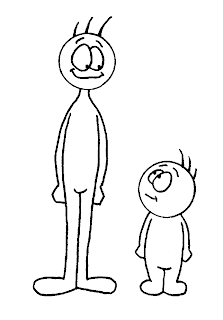
Something did occur to me after my friend left. If I had lived my life on a desert island, never having met another human being, would I be shy? Would I be tall if there was no Yvonne, Da Eun or Jennie Bond around me to compare my height with? Would I be male if there was no female? Who am I – really?

Isaac Newton argues that action and reaction are inextricably linked – the one defines the other. Community life similarly offers us all, able and less able, shy and loud, tall and short, an opportunity to be, to exist, to define ourselves through our relationships, to offer a place for us to act and be.

Psalm 68 states that ‘God sets the lonely in families’; he roots the lost – all of us – in community where we can find identity and meaning.

So perhaps the conclusion of all this is that without ‘community’ or society, there is no ‘me’.

‘No man is an island, entire of itself; every man is a piece of the continent, a part of the main. If a clod be washed away by the sea, Europe is the less, …as well as if a manor of thy friend's or of thine own were: any man's death diminishes me, because I am involved in mankind, and therefore never send to know for whom the bells tolls; it tolls for thee.’

John Donne, 1624.

The God of small spiders


Whilst she was in the Faith House garden, Gillian sat and watched a spider at work in his web. The spider had built a web which stretched diagonally all the way from the side of the house to a bush, six foot from the wall. The web was a single strand of cobweb and in the middle of the strand, the spider was busy building his net of cobwebs into a structure. Gillian commented: ‘How can people say there is no God?’

Whether you like spiders or not, you have to admire their ingenuity. Wherever you walk in Autumn, you see cobwebs spanning the most improbable places – I have a spider that daily builds a cobweb over the wing mirror of my car, only for the web to be blown away every day on the way to Little Ewell.

The spider’s willingness to exploit every opportunity can be good metaphor for us.

Spiders have faith and persevere: Cobwebs gather every week in the corner of your house, only to be swept away every week in your weekly clean, yet the spider returns and builds again the following week. I have never met a spider that has complained to me that the bush and the wall are too far apart. Every new web does not promise a juicy spider, but no spider ever caught his lunch without spinning a web. In the letter of Timothy (4: 5-7), Timothy writes: ‘But you…endure hardship,….fulfil your ministry. I have fought the good fight, I have finished the course, I have kept the faith’.

More than this though, the spider describes a way to approach life and understand God within it. God provides the brick wall, the bush, the wing mirror, the structures that surround us. Our job, and that of the spider’s, is simply to use each one of these gifts as well as we are able, to build a life for us and our community. And in doing so, others will draw inspiration, find faith and perhaps exclaim:

‘How can people say there is no God?’